

Axion Medevac
A Stokes-type basket litter with tie-down straps mounts on top behind a debris shield, with vital-signs telemetry and easy side access even with all engines running. Flies fully autonomously.
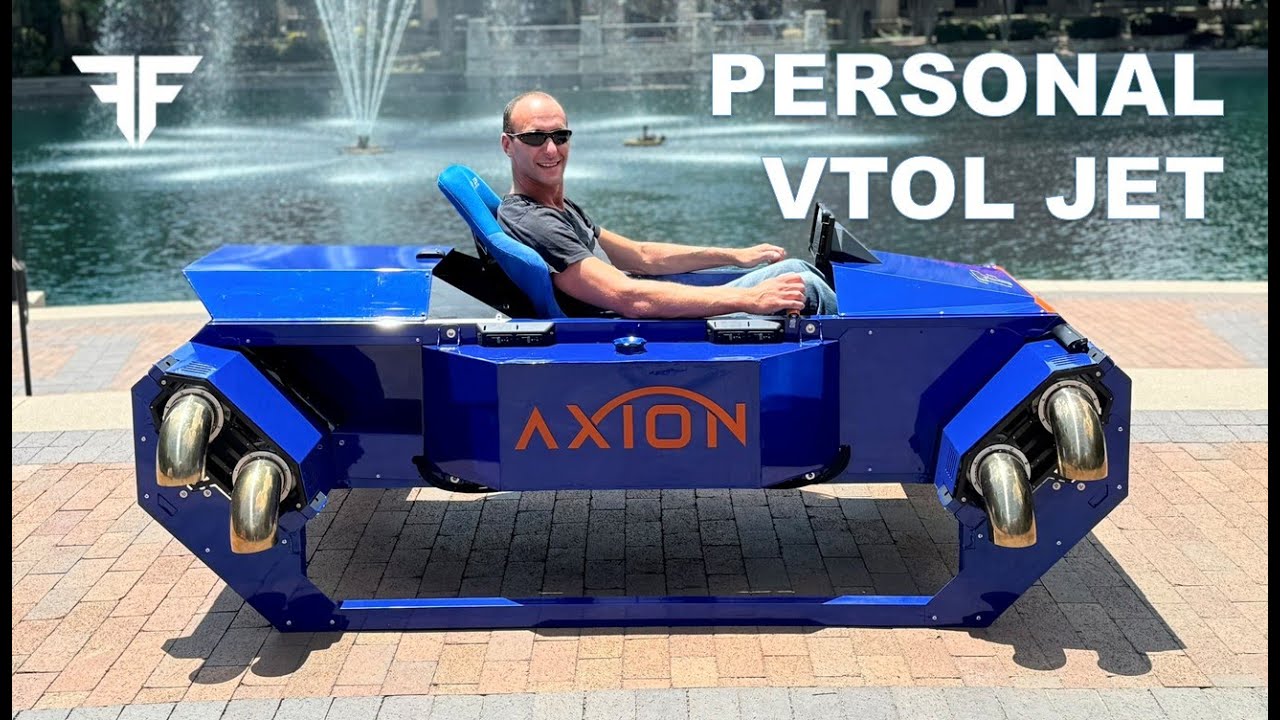
Eight thrust-vectored micro jet engines power this diesel-fueled VTOL for manned or unmanned missions. A scaled-up version of the flight-proven JetQuad.
Price starting at:
199,995.00 USD

One platform for personal flight, medical evacuation and heavy cargo.
Your own flying supercar, built for personal aviation and next-generation aerial racing leagues, with exceptional agility and power.
Rapid, fully autonomous life-saving transport with swift vertical access to remote or urban hotspots, with vital-signs telemetry for the patient.
Hauls substantial payloads autonomously over challenging terrain, ideal for logistics, construction and disaster relief.
What sets a jet-powered VTOL apart from propeller-based eVTOLs.
A flat design cuts drag in forward flight for faster cruise. At 87 × 63 in (2.2 × 1.6 m), its compact footprint fits in a standard parking spot.
Horizontally mounted engines sit safely inside the frame, making turbine starts more reliable, the vehicle quieter and servicing easier.
Two cross-linked 15-gallon (57 L) tanks with baffles free up the center of the aircraft, making room for a comfortable, well-positioned pilot seat.
Cruises at 155 mph at sea level, with quicker acceleration than comparable propeller-driven eVTOLs for superior speed and maneuverability.
Runs on diesel, biodiesel or Jet-A from almost any gas station, and refuels in under four minutes instead of hours of battery charging.
Jet engines hold up better in cold and at altitude, and thrust vectoring gives direct control without aerodynamic surfaces in winds up to 42 mph.

“The Axion Recreational (AX1-R) is fueled by gas-station diesel and fits in a standard parking spot: a true flying racecar.”

Protection for operators, the ground and emergencies.
At ignition and idle, exhaust is directed only forward and rearward, so it never scorches the ground and operators can safely approach from either side.
The eight engines work in pairs. If one fails, its paired engine spools up and the flight computer brings the aircraft down in a smooth emergency landing.
Triplex-redundant flight control, with real-time obstacle avoidance and automated recovery being integrated now and in-flight testing planned.

Fly hands-on or let the flight computer navigate. Either way, it keeps the aircraft within safe limits.
Set heading, speed and altitude with intuitive joysticks, and the flight computer turns them into precise, safe maneuvers. Needs only basic training, far less than a pilot's license.
Tap a destination on the onboard tablet, and the Axion is designed to plot the route, start its engines and fly there on its own. In-flight testing is planned.

Reconfigure the Axion in hours. Both versions are designed for full autonomy, with room for a pilot when the mission calls for one.
A Stokes-type basket litter with tie-down straps mounts on top behind a debris shield, with vital-signs telemetry and easy side access even with all engines running. Flies fully autonomously.

A large drone for big, irregular cargo: secure internal payloads, external sling loads for oversized items, or extra tanks to serve as a fuel tanker on long-range missions.